
 |
|||||||||
|
Issue #3 · October 20, 2026 Hey {{ first_name | default: "friend" }}! Issue #3 of Stop Being the System. Last time we talked about what the copy and paste work in your business actually costs you. This time we're going to address why you have to see what's going on before you try to grow it. |
|||||||||
You can't fix what you can't see Most businesses want to grow before they can see what's going on inside them. More customers, more hires, more tools. The trouble is that growth adds volume to whatever you already have. If work is hidden, more of it gets hidden. So get it visible first. Not a dashboard. Just three questions you can answer in under a minute:
The first two are usually fine. The third is where the cost hides. The stuck list is the follow-up promised in a meeting that nobody wrote down. The customer waiting on a reply nobody owns. The yes that never turned into a task. None of it shows up on a task list, because it never became a task. It lives in a conversation, and conversations don't remind you of anything. If you can't answer those three questions without asking someone, you don't have a growth problem yet. You have a visibility problem.
|
|||||||||
|
|
|||||||||
What is context? Context is everything the AI can see when it answers you. Your question, the earlier messages in the chat, any files you pasted, and any standing instructions. It also includes memory. Some tools can save notes about you and bring them into new chats. It's not quite AI remembering the way you do. It's limited to specific things it identified it might want to remember, but those notes get loaded in at the start, so they count as context too. Anything outside that, it can't see. It doesn't know your business unless it's in there. That's why the same question gets a great answer for one person and a useless one for another. Different context. Same rule as your business: AI can't help with what it can't see. If the answer feels generic, the context was thin. Add three things: who it's for, what good looks like, and one example. |
|||||||||
|
|
|||||||||
Spot the silent “yes” How many times do you agree to something without writing it down or even realizing you committed to it? This week's experiment: catch the commitments (the "yes" you gave) before they disappear. For the next five days, take two minutes at the end of the day and ask: "What did I agree to today that isn't written down anywhere?" Check your chats, your email replies and your meetings. If AI has your notes or transcripts, ask it the same question. Write each one wherever you'll actually see it tomorrow. Last week was about organizing a mess after the fact. This one is about catching the small commitments as they happen, before they turn into the stuck list. |
|||||||||
|
|
|||||||||
The 4-Hour Workweek
Ferriss is talking about hiring, but it's true of any kind of growth. Get the process working and visible first, then add to it. It applies to AI too, even though the book was written long before it. AI is one more thing you can add to a process. Add it to a poor one and you multiply the problems, only faster. |
|||||||||
|
|
|||||||||
What fell through the cracks I started using my Chief of Staff agent a bit differently this week. Instead of handing it tidy tasks, I had more stream-of-consciousness conversations with it. It got SO much more done. It also left me feeling like things were all over the place and I was missing something. So I ran last week's experiment on myself. I asked it to go back through the week and tell me three things: what's in progress, who owns it, and what's stuck. The in-progress list was long but fine. The surprise was the stuck list. An approval I'd typed but never actually sent. A project I'd said yes to that never started. A job that died halfway through and just sat there. None of it was on a task list, because none of it had become a task yet. It lived in the conversation, and conversations don't remind you of anything. Talking is a great way to get things moving and a terrible way to keep track of them. I built it into my system now that my Chief of Staff agent now keeps track of these open loops. In the short term though I'm still going to try ending each day by asking for that same list to make sure we are aligned. |
|||||||||
|
|
|||||||||
|
Thanks for reading. Hit reply and tell me one thing in your business that's stuck right now because nobody is tracking it. I read every reply.
|
|||||||||
|






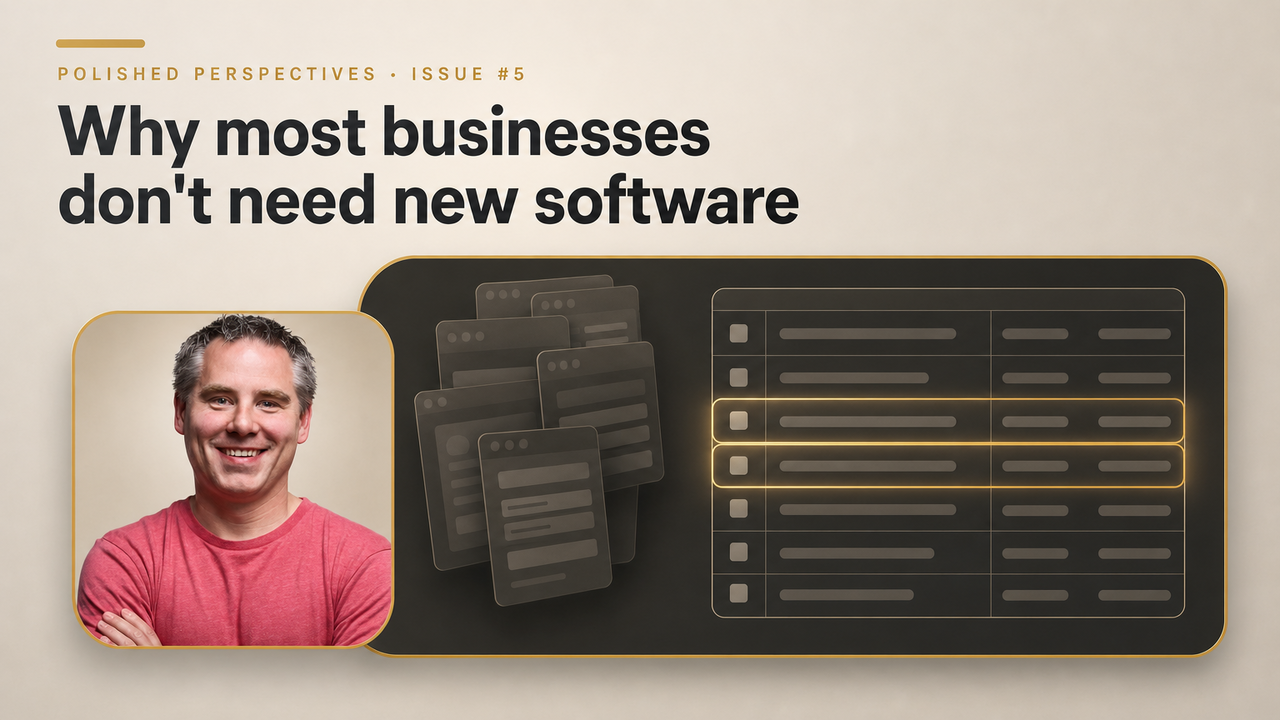 Issue #5: Why Most Businesses Don't Need New Software
Issue #5 · November 3, 2026
Hey {{ first_name | default: "friend" }}!
Issue #5 of Stop Being the System. Last time we talked about why a single source of truth starts with agreeing on what the words mean. This time we're going to address why fixing the process usually beats buying another tool.
Featured · Polished PerspectivesBuild a mini app. Own 100% of your code.Had the thought "I wish the...
 Issue #4: The Single Source of Truth
Issue #4 · October 27, 2026
Hey {{ first_name | default: "friend" }}!
Issue #4 of Stop Being the System. Last time we talked about why you have to see what's going on before you try to grow it. This time we're going to address why a single source of truth starts with agreeing on what the words mean.
Featured · Polished PerspectivesBuild a mini app. Own 100% of your code.Had the thought "I wis...
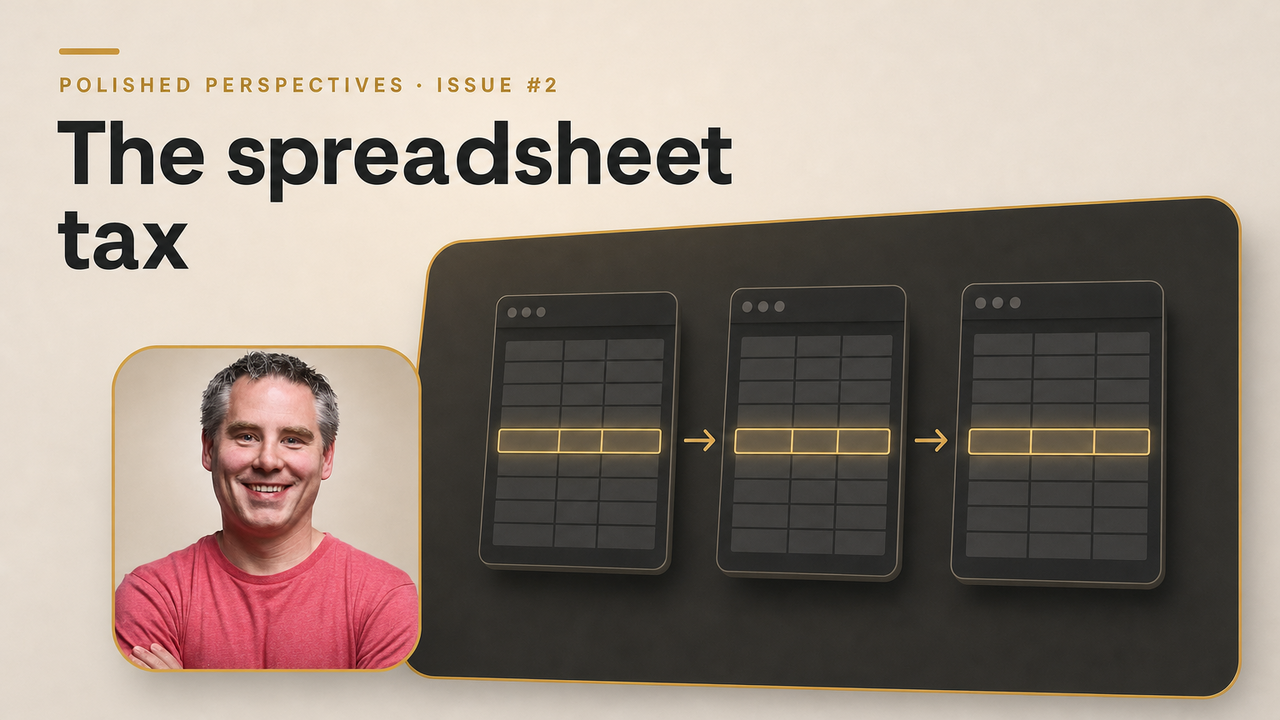 Issue #2: The Spreadsheet Tax
Issue #2 · October 13, 2026
Hey {{ first_name | default: "friend" }}!Issue #2 of Stop Being the System. Last time: why a business can have more software than ever and still feel chaotic. This time: what that chaos actually costs you.Featured · Polished PerspectivesBuild a mini app. Own 100% of your code.Had the thought "I wish there was an app for that"? My course shows you how to build it y...
 Polished Perspectives

Responses